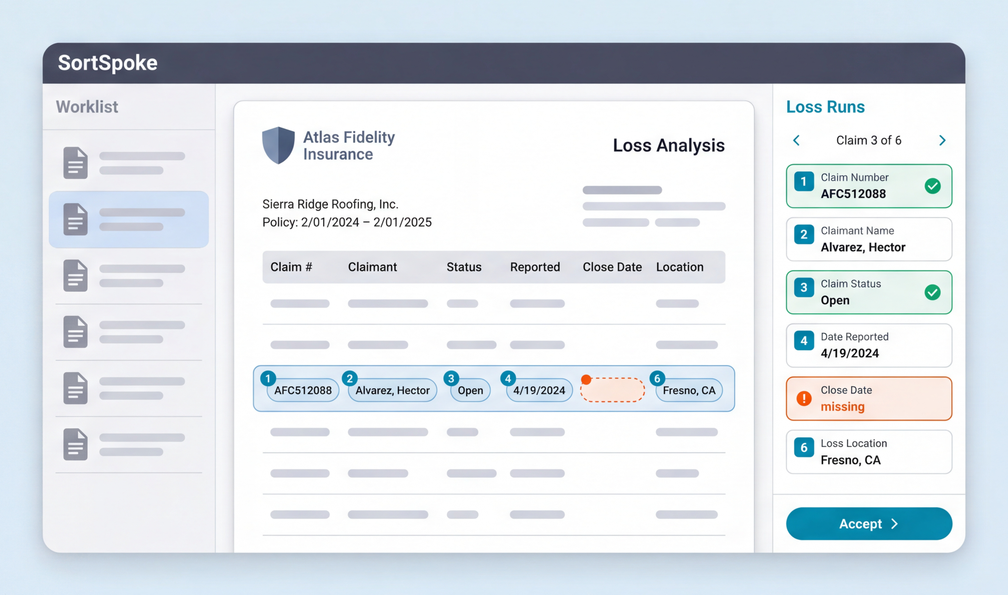
SortSpoke for Loss Run Reports
Every field extracted from a loss run traces back to the source document and the person who reviewed it — bring your own loss runs and see live results, not a canned demo.
SortSpoke is insurance document AI: we turn submissions, loss runs, and the rest of your document intake into verified data — inside the systems your team already works in.
If you're evaluating how to get clean claims data out of loss runs, you're weighing the same four options as every underwriting team. Here's the honest comparison.
Underwriters or assistants rekey claims data line by line. Accurate on any format — but it doesn't scale. A multi-carrier loss run takes hours, and industry estimates put up to 40% of underwriters' time on administrative work.
A human-powered service keys the data for you. It works — but the vendor's staff sit in your critical path: throughput depends on their headcount and shift coverage, turnaround is measured in hours or days, and cost scales with people rather than documents.
Generic document AI — or a DIY LLM pipeline — handles clean, consistent forms well, then breaks on the messy reality of multi-carrier loss run formats. And when it's wrong, nothing governs, verifies, or traces the output.
Straight-through platforms route only what the model itself flags as low-confidence to review. A confidently-wrong extraction never surfaces — you find it at renewal, or in an audit.
AI does the extraction. Your people — and only your people — verify it. You set the confidence thresholds that decide what gets reviewed, and every field traces back to its exact place in the source document. Accuracy is governed, not promised.
Built for underwriting teams that need the speed of AI and the accountability of their own reviewers.
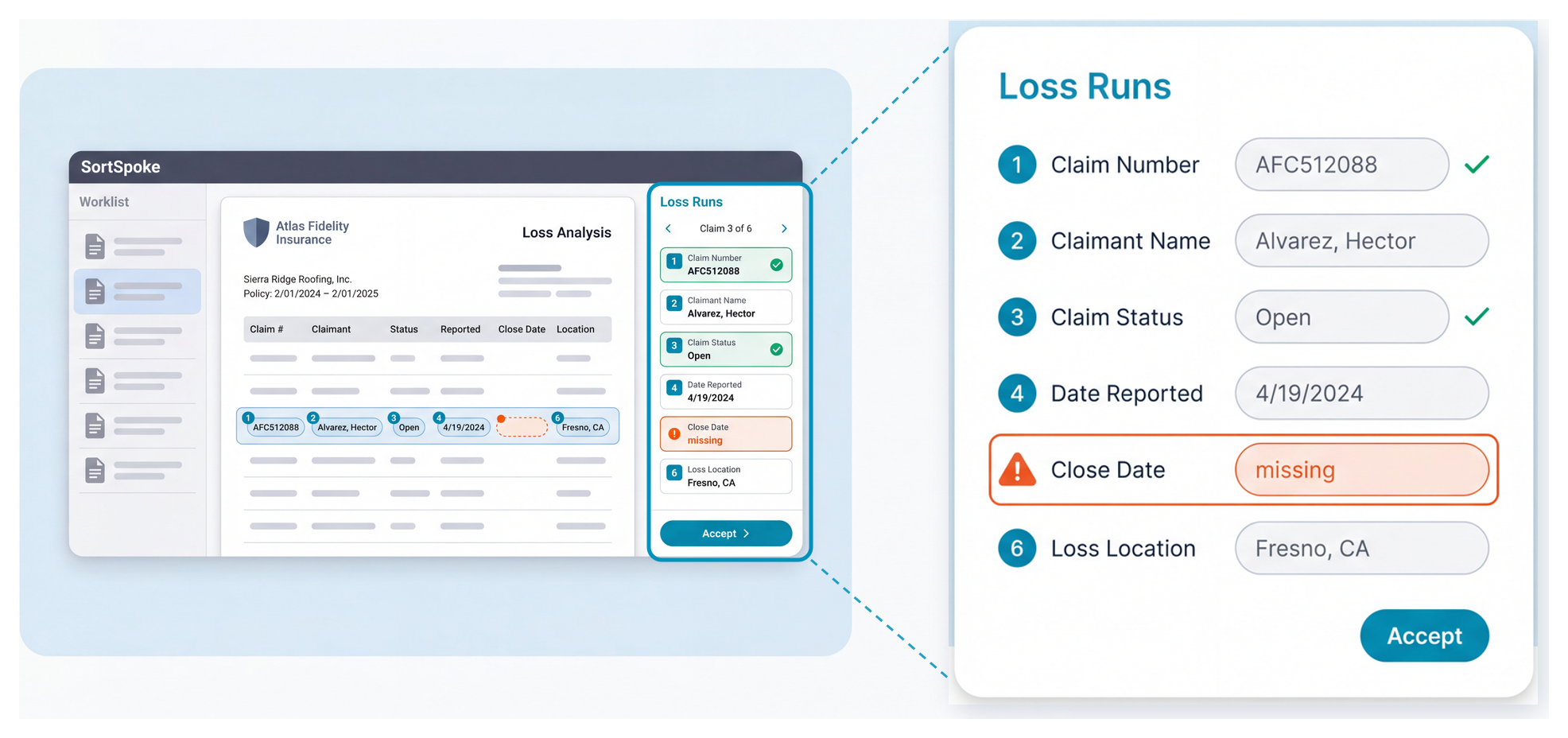
Every extracted field either clears the confidence bar you set or goes to your reviewers. What gets human review is governed by your rules — not by the model's opinion of itself.
Click any extracted value to see exactly where it came from in the source PDF — with an audit trail of who reviewed it, what changed, and when. Your underwriters don't have to trust the AI; they can check it.
SortSpoke is one of the few extraction platforms built to run inside your underwriting workbench, intake inbox, or policy admin system. What lands in your system of record is verified data your team can check — not a recommendation you have to trust.
There's no vendor review pool behind the curtain. Cost scales with documents, not people, and your throughput never depends on anyone else's headcount or shift coverage. The only humans in the loop are yours.
From messy, multi-carrier loss runs to clean claims data — here’s the pipeline.
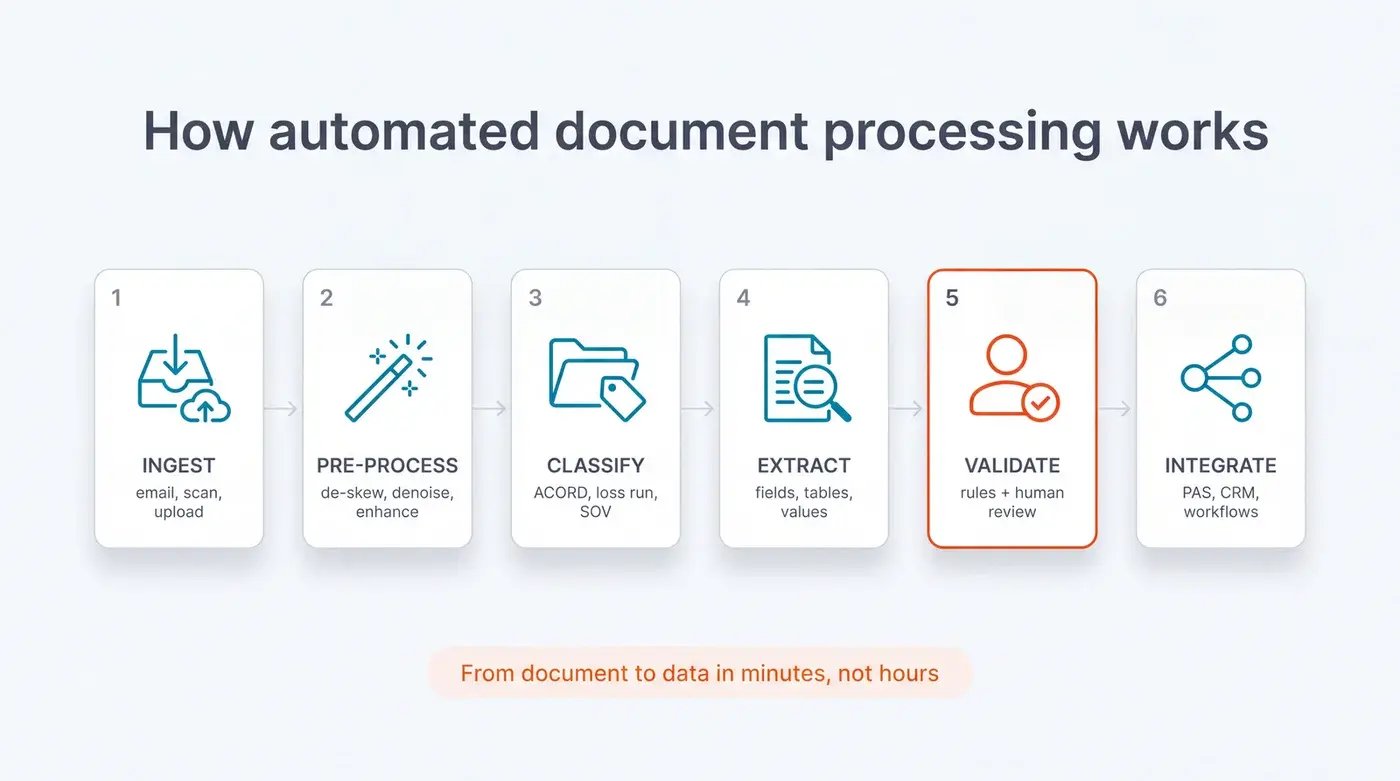
SortSpoke isn't another portal. Loss run extraction and underwriter review run inside your existing underwriting workbench, intake inbox, or policy admin system — so adoption doesn't depend on changing how your team works.
AI extracts and standardizes the claims data; your underwriters review and approve without leaving the tools they know. The clean loss data lands in your system of record, ready for risk assessment.
Process loss run submissions 5X faster — Great American.
Extraction accuracy on real-world loss runs, measured on production data — and every field either clears the confidence threshold you set or your reviewers make the call.
Live in 30 minutes. Go from sign-up to extracting your first loss runs in under half an hour.
At SortSpoke, we understand that document processing in insurance and financial services demands the highest levels of security and compliance. Your sensitive data never leaves your control.
Our Security Foundation:
SOC 2 Type II compliant infrastructure built on AWS
Role-based access controls
Comprehensive audit logging and monitoring
By clicking Book Now you're confirming that you agree with our Terms and Conditions.
Enter your email and go straight to the calendar — pick a demo time that works for you. Then bring your messiest loss runs and watch the extraction live.
Quick reference: what a loss run is, what one contains, and how to read it.
Definition
A loss run is a report issued by an insurance carrier that lists a policyholder's claims history over a set period — typically three to five years.
Each entry records the claim date, type, status, amount paid, and reserves. Underwriters use loss runs to assess risk and price renewals. Every carrier formats them differently, which is what makes them slow to process at scale.
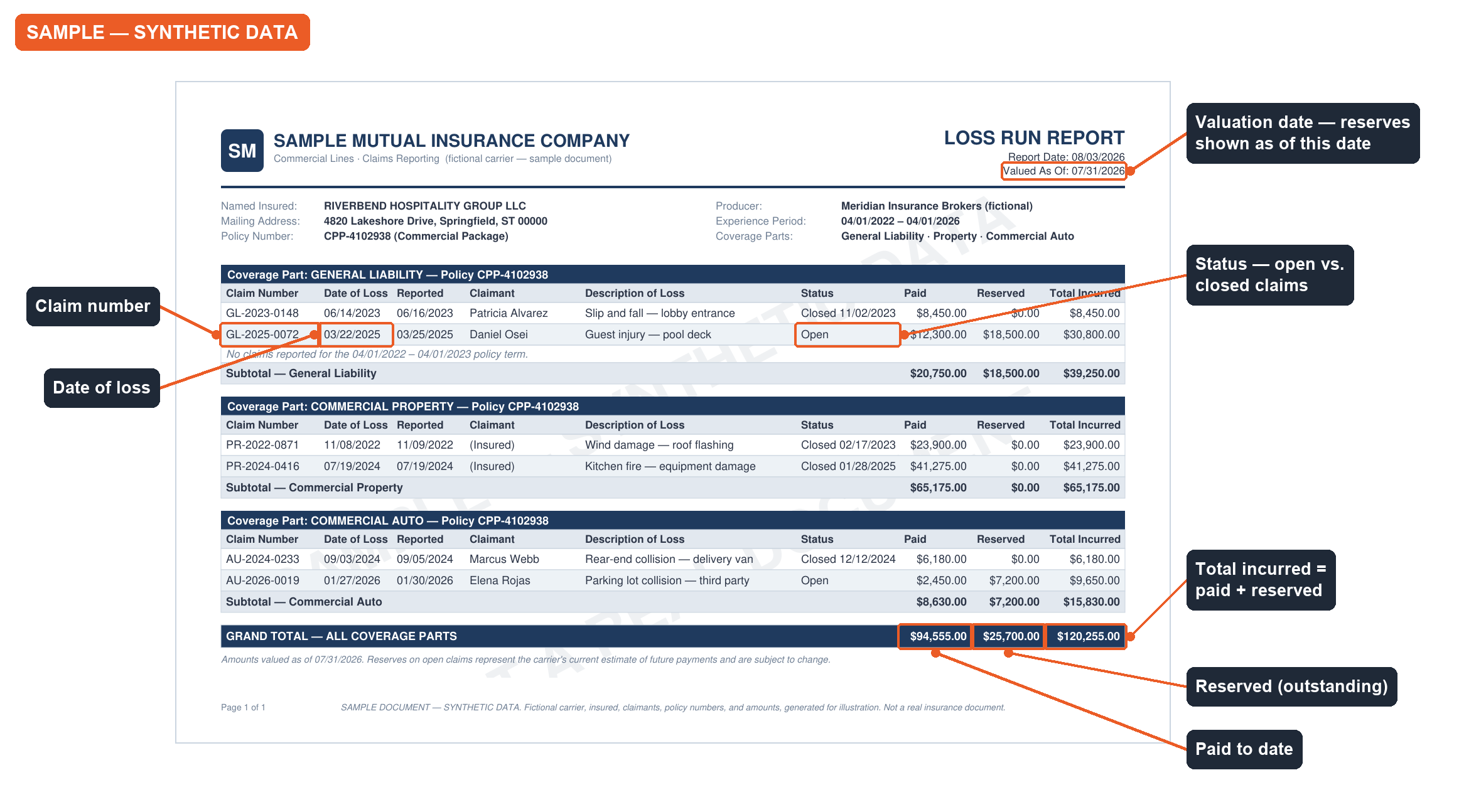
A loss run report typically contains the policy number and effective dates, a line per claim with date of loss and claim status (open, closed, or reopened), amounts paid, outstanding reserves, and a total incurred figure. Carriers vary in whether they include claimant detail, cause-of-loss coding, and subrogation recovery.
Most submissions ask for three to five years of loss history. A 5 year loss run report is standard for commercial lines; a 3 year loss run report is common for smaller accounts.
Read a loss run by first checking the policy period and whether the report is valued to a recent date. Then review each claim line for status, paid amount, and reserves. Total incurred is paid plus reserves. Open claims with large reserves carry the most forward-looking risk.
Industry estimates put up to 40% of underwriters' time on administrative work — much of it manual document handling like loss run processing. At 1,000 submissions a month, that's roughly 500–1,000 hours of underwriter time on loss run processing alone — time an automated extraction workflow gives back to risk assessment.
© 2026 Mocsy Inc. (o/a SortSpoke). All Rights Reserved.